The creative process
Making sense of sense-making
Every project — live capture, policy cartoon, gathering or workshop — runs on the same engine: a proper conversation, and a pen.
Where “sense-making” comes from
For years I struggled to articulate what Visual Thinkery actually is — a trifle embarrassing, given I’m in the business of helping others articulate their messages. Words like visual thinker or cartoonist fall short of key ingredients like active listening and ideation.
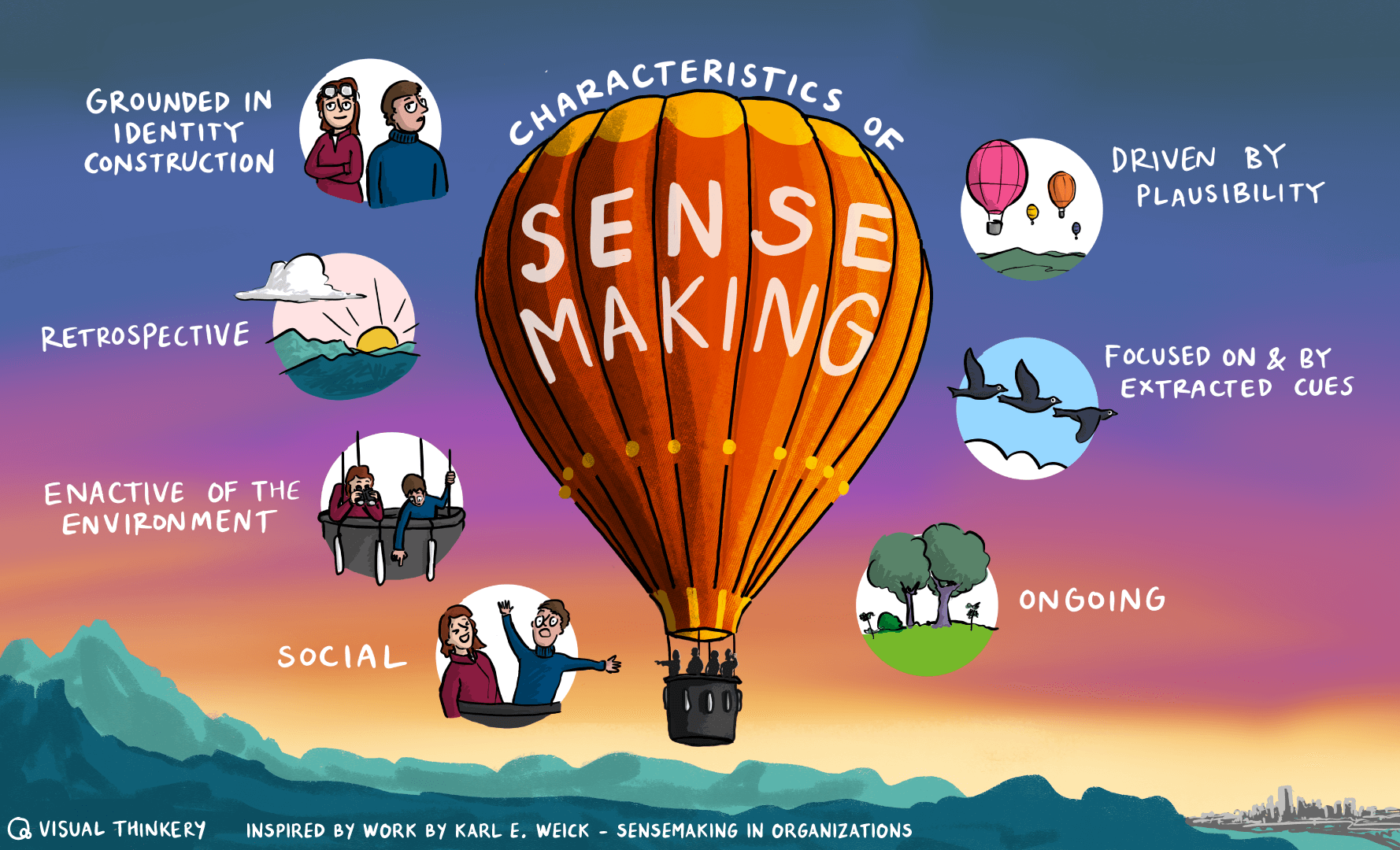
Then, mid-conversation, a client reflected that what we were doing together was sense-making — and that compound word was a moment of clarity. Karl E. Weick, who coined it, researched how people construct meaning in ambiguous, uncertain or complex situations. (The puzzle of constructing visual meaning in complex situations is exactly what butters my parsnips.) So I used his seven characteristics of sense-making as a frame for reflecting on the Visual Thinkery process — and of course, I had to draw some thinkery to make sense of it all…

1. It’s grounded in identity
I try to create a space where people can be themselves — bring their stories, perspectives, opinions and humour. This is personal, dammit! A diversity of perspective leads to a richer conversation, and hierarchy in the room can quietly obstruct creative openness.
2. It’s retrospective
We often don’t know why something matters until we look back and connect the dots. Everyone sees a different world through their own experience — so we articulate the future by drawing meaning from the past.

3. It creates the environment
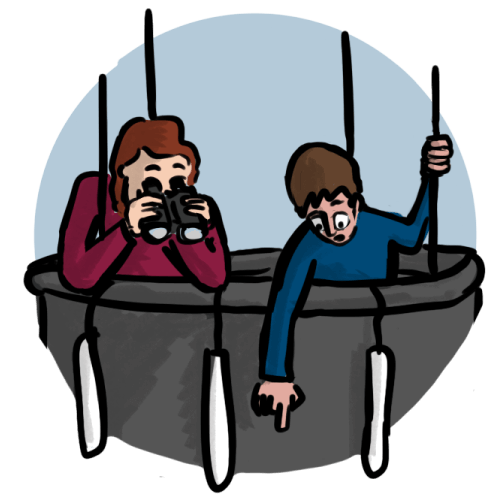
Sense-making isn’t just capturing how things are. Every doodle of something said becomes a prompt and a reference point — a new stepping stone for the group’s shared imagination.
4. It’s social
No idea is an island. Even having an outsider (or curious idiot) like me in the room prompts a different language amongst colleagues — stories bubble to the surface to illustrate and explain.


5. It’s ongoing
It’s a living process. One story sparks another; one sketch paints a new reality for the conversation. Add more participants and new meanings arrive with them.
6. It hangs on extracted cues
A tiny detail, a quirky phrase, a humorous aside — these become the cues that anchor shared meaning. We naturally reach for metaphors, and as we do, others start to see pictures and build on top.


7. It runs on plausibility, not accuracy
The goal isn’t factual truth — it’s a plausible, workable, coherent (and truthful!) story that resonates. In an exploratory conversation, little fragments of sense materialise and come into view. Quick — capture them before they escape!

“We find the gold in conversation, and articulate it visually.”
— the Visual Thinkery creative process
Whether it’s a live capture of a gathering, a creative process to make a visual asset, or a reflective journaling of growing up in Ulster — at its core is a puzzle of meaning, just waiting to be solved.